




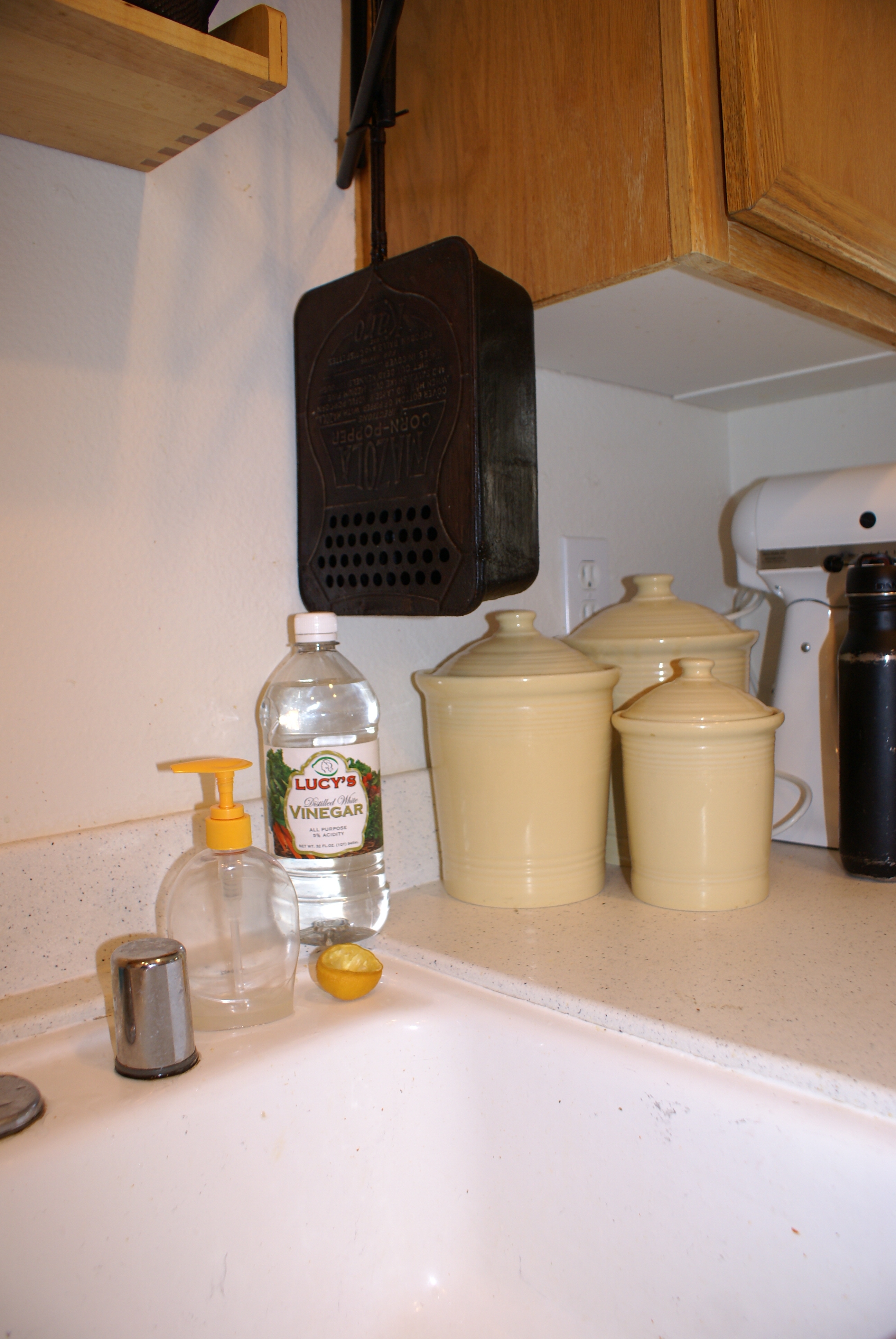
Vinegar for cleaning. Notice the cut lemon, also for cleaning.
Distilled white vinegar is a mixture of acetic acid and water. It’s cheap and effective for many uses. I use it to cook and clean in various ways. [Notice the cut lemon in the picture above, which is also useful for cleaning.]
Vinegar for cleaning
The most common way I use vinegar is mixed half and half with isopropyl rubbing alcohol. This 50/50 alcohol-vinegar mixture is a useful, non-toxic disinfectant. We keep a squeeze bottle of it in our bathroom for wiping up spills and splatters (I have a toddler and 2 teenage boys – enough said.) We also use the squeeze bottle to drip a few drops of the alcohol-vinegar mixture into our ears after swimming and sometimes even after showering. The alcohol works to dry up any water caught in the ear and the distilled white vinegar prevents infection. Not matter how you use the mixture, the smell is strong, but it dissipates quickly as the alcohol and vinegar evaporate and is completely gone within a few minutes. I also use vinegar in another mixture with alcohol, but it is cut with water so it isn’t quite as strong. It is only used for cleaning and it smells better because it incorporates tea tree and lavender oils.
Vinegar can also be used on its own to clean many surfaces. It is useful for glass, windows and mirrors, as well as stainless steel and ceramic surfaces like stoves and fridges. If you need or want something a bit abrasive, you can use baking soda along with the vinegar. The baking soda acts as a scrub, but it’s too fine to scratch most surfaces. This combination of baking soda and vinegar is commonly used – along with red and orange food coloring – to create volcanoes for school science projects. It will bubble and fizz, so don’t try to store it in a container – just sprinkle some baking soda on the surface to be cleaned and have at it with a sponge dipped in distilled white vinegar. Alternatively, you can take your vinegar soaked sponge and dip it in baking soda – this method is easier for cleaning inside things like the microwave or fridge.

Vinegar and baking soda bubbling in sink.
Vinegar for stinky trash cans
For cleaning stinky trash cans, the fizziness of the baking soda and vinegar combination is actually quite helpful in getting the cleaning started for you. And, both vinegar and baking soda are products that neutralize smells – so the combination is like a one-two punch against stink! Sprinkle some baking soda into your trash can, pour in some distilled white vinegar and let the bubbles get at the gunk. Follow up by pouring in some extra, extra hot water to rinse it all out.
Vinegar for laundry
Just like vinegar works on stinky trash cans, it will also take the stink out of clothes and towels. Clothes and towels can get detergent built up on them and start to look dingy and dull – this build up will even attract and trap dirt and smells more than normal. To combat this, pour a cup of distilled white vinegar in at the beginning of the rinse cycle. You don’t need to use vinegar with every wash, but it’s a good idea to do it once in awhile.
Vinegar for garden weeds
My current home has a balcony, so I have a container garden and weeding isn’t really an issue for me. But, if you find yourself struggling with weeds and wanting to turn to something to kill them, try distilled white vinegar. It’s far safer for pets and people than anything else on the market and it works. Just fill a spray bottle with vinegar and douse the weeds in it. Wait a day or two and they should die and dry up – then, just pull ’em out!
Vinegar for coffee makers and tea kettles
Vinegar is perfect for cleaning gunk and mineral deposits out of coffee makers and tea kettles. Instead of just water, pour some distilled white vinegar into your coffee maker or tea kettle (but not while you’re actually making coffee or tea!) and run it through or boil it up. Run through or boil up some plain water afterwards to rinse out the vinegar.
Vinegar for hard boiling eggs
We’re mostly vegan in my home – mainly for health and environmental reasons – but we’re not completely opposed to eggs and dairy. I haven’t hard boiled eggs in a very long time, but when I did, this vinegar trick really helped. Drop a tablespoon of distilled white vinegar into the pot of water when you start your eggs. It helps keep the egg together if it cracks and helps with getting the egg to shrink away from the shell to make peeling easier.
Vinegar for salad dressing
This one is obvious – vinegar is the main ingredient in vinaigrette, the other component is oil and whatever sweetener or spices you desire. Vinaigrette can be made from distilled white vinegar, apple cider vinegar, balsamic vinegar, rice wine vinegar or any other kind of vinegar actually. Lately, I’ve been really into cucumber and tomato salad with red onion and a greek yogurt vinaigrette. I just cut up the veggies and mix in some greek yogurt and 1-2 tablespoons of distilled white vinegar – you can add cumin or coriander and sugar if you like, but I prefer my plain.

Vinegar for aftershave.
Vinegar for bug bites, sunburns and aftershave
Distilled white vinegar is perfect for soothing a sunburn and taking the sting out of bug bites. Just pour some on a cotton ball and dab it on your skin or hold it on the bug bite for a minute. Vinegar is also a good aftershave. It soothes the skin, but can leave you smelling a bit like a salad for awhile, so I recommend mixing it with some essential oils – I recommend lavender for women, bergamot for men and tea tree for both. You can also use apple cider vinegar (ACV) for these purposes.
These are just a few of vinegars many uses – including cleaning shells. So, how do you use vinegar?
Organic apple cider vinegar is the best hair conditioner i ever used!
Maria,sometimes I use apple cider vinegar for my hair, when I feel it’s got shampoo build up. I tried only using ACV but it didn’t work well for me. I’ve found that a simple sulfate free shampoo is best for me.